
The Common Outcomes for Children and Young People Collaborative welcomes the recent publication of Foundations’ Outcomes Framework and Measures Database, an important contribution towards more coherent, evidence-informed approaches to defining, capturing and, most importantly, improving outcomes for babies, children and young people, their families and communities.
We particularly welcome the way the development of Foundations’ framework built on existing work, including the Collaborative’s key tool, the Common Outcomes Framework, and our guidance on shared language - strengthening connections and supporting movement towards a coherent outcomes landscape.
A central ambition of the Common Outcomes Collaborative is to create greater alignment between those planning, funding, delivering and evaluating services around the outcomes that matter most, especially for children and young people themselves.
Organisations and partnerships often work towards similar goals while describing, measuring and evidencing outcomes in different ways, making it harder to learn from each other, build understanding and bring together the evidence of what’s most likely to deliver the greatest impact. Our common approach to outcomes should help us hear and see children more clearly, not reduce their lives to the boundaries of individual policies, services, funding streams or datasets.
The two frameworks are closely connected, but distinctive.
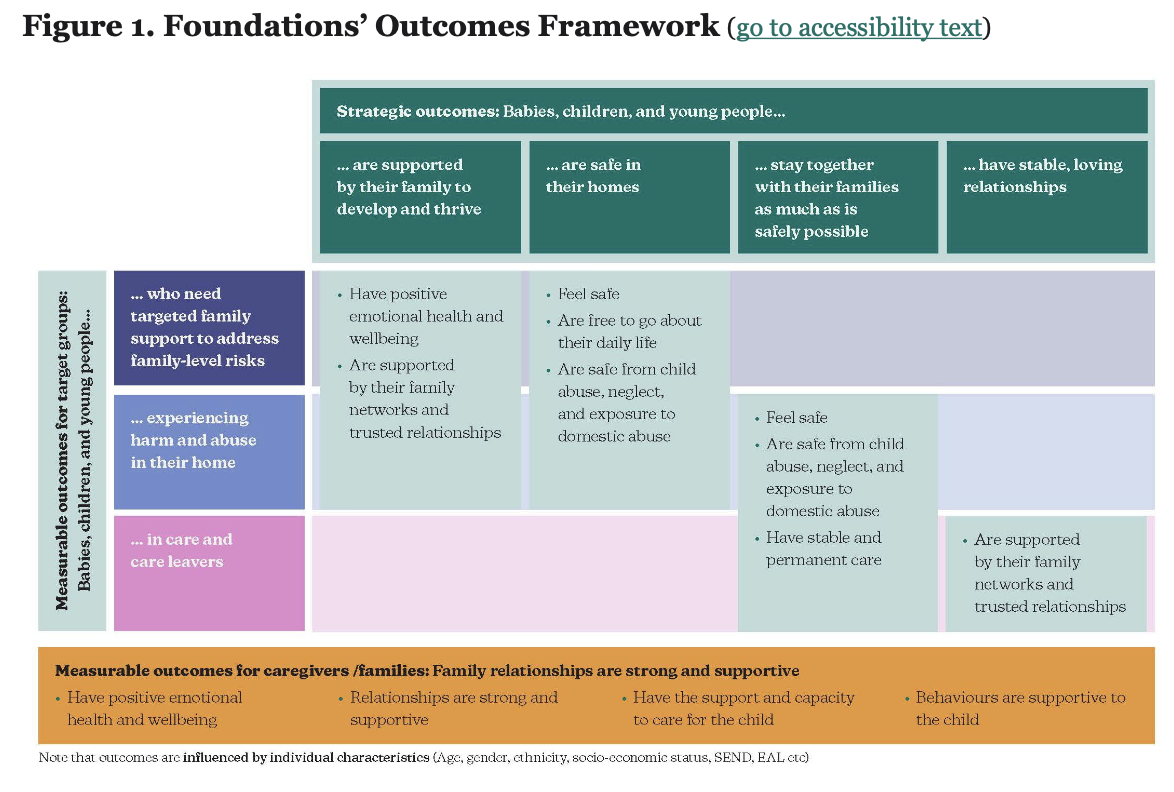
The new Foundations’ Outcomes Framework is designed around Foundations’ strategy and remit. It provides a more specific framework for children and families within Foundations’ areas of focus – those children affected by family-level risks, harm or abuse at home, and children’s social care, including children in care and care leavers. It complements the Common Outcomes Framework, alongside other more detailed frameworks created through the Collaborative’s test and learn partnerships, for example the Family Hubs and Beyond (FHAB) framework, co-produced with London boroughs.
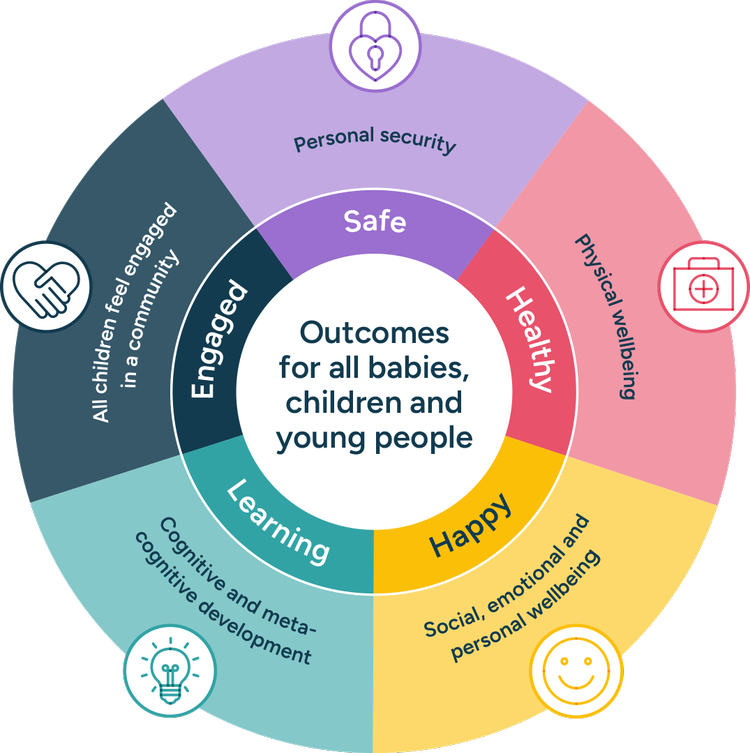
The Common Outcomes Framework has a broader, system-wide purpose. It offers a shared and holistic picture of what it means for babies, children and young people to be Safe, Healthy, Happy, Learning and Engaged. Its scope extends across physical and emotional health and wellbeing, education and development, community and online safety, and opportunities for play, participation, voice and belonging. It is designed to support systemic change by providing a shared language and common direction for partners, helping them align strategy, commissioning, evaluation and practice around the overarching conditions all babies, children and young people need to thrive.
Rather than competing with our common outcomes approach, more specific, specialist frameworks provide the depth needed for specific populations, services and interventions, exemplified by the Foundations’ Outcomes Framework covering the evaluation of services and interventions for their target populations. The Common Outcomes Framework helps partners see how existing and more specialist and specific frameworks fit together, where they reinforce one another and where gaps remain. Used together, they can help us to strengthen evidence within individual fields while supporting more aligned priorities, coordinated decisions and more effective targeting of resources across the wider children’s system.
A key challenge emerging frequently through the Collaborative’s test and learn partnerships is how to measure the difference we’re making for children and families and which measurement tools are most relevant, appropriate, affordable and feasible for each specific circumstance.
The Foundations’ Measures Database lists over 200 validated measurement tools that could be used to capture impact across areas such as emotional wellbeing, safety, trusted relationships, stable care, family relationships and caregivers’ capacity to support children. The database focuses on outcomes for children who need targeted support to address family-level risks, and quantitative evaluation measures to capture these. This provides a useful starting point for those working to understand and improve these outcomes for babies, children and young people more broadly.
We congratulate the Foundations’ team and everyone involved in developing these resources. We look forward to continuing to work together to build a connected outcomes ecosystem in which specialist expertise and shared frameworks work together to strengthen learning, improve decision-making and support better outcomes for children and families.
For a fuller list of relevant measurement tool data bases please follow this link.