Best Start in Life
Improving outcomes for babies, children and families is at the heart of the government’s Opportunity Mission and Best Start in Life strategy. Recent Best Start Family Hubs and Healthy Babies guidance from the Department for Education sets a clear expectation: local areas should take a more joined-up, outcomes-focused approach, bringing partners together around shared priorities and integrated delivery.
At the same time, Nesta is supporting local areas to strengthen strategic planning and delivery through its Best Start in Life offer emphasising the importance of combining evidence, data, behavioural insight and test-and-learn approaches to drive meaningful, sustained improvement.
A central message across both is clear:
All partners should have a shared understanding of and commitment to the outcomes they want to achieve.
A practical starting point: the London Family Hubs and Beyond shared outcomes framework
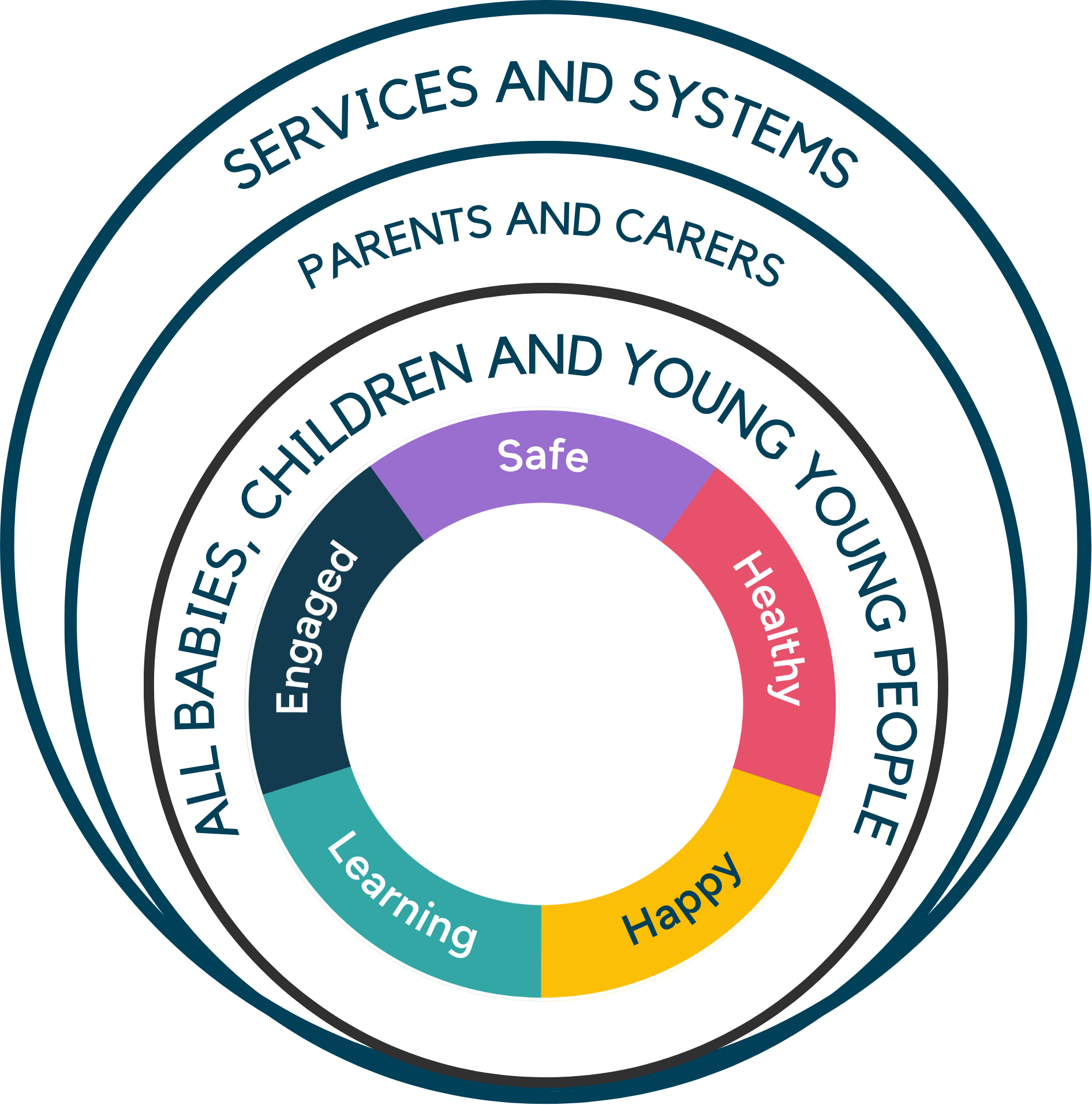
Alongside the collaborative efforts to co-produce the Family Hubs and Beyond (FHAB) shared outcomes framework, Mapstone and Associates, working with the London Borough of Hackney and the London Borough of Merton, have created accompanying data tools – a ‘super-spreadsheet’ with links to other outcomes frameworks incorporated into the FHAB framework (Supporting Families, Children’s Social Care, Public Health Outcomes Framework, Local Outcomes Framework). The spreadsheet can be set up for each local authority (using the Setup tab) and updated using the link to the LGA’s LGInform tool (using the Update Instructions tab). A video has been created to share the background to and uses of the spreadsheet.
The ‘super-spreadsheet’ hasn’t yet been updated to match the latest (fourth) iteration of the FHAB framework published in September 2026. The Common Outcomes Collaborative continues to explore opportunities to update it and which partner might be best placed to lead this work into the future.
The Family Hubs and Beyond (FHAB) shared framework provides a practical starting point to deliver on the Best Start in Life ambition and wider reform and transformation across local children’s services and partnerships.
The Common Outcomes Framework and the holistic approach encouraged by its five high level domains – safe, healthy, happy, learning and engaged – were used by a collaboration of London boroughs, supported by the Common Outcomes for Children and Young People Collaborative, to co-produce a shared outcomes framework, starting with a focus on Family Hubs and now beyond across wider children’s services, partnerships and systems.
It provides a shared, strengths-based structure for defining, measuring and improving outcomes for babies, children and young people, and for parents and carers, and the service/system level indicators most relevant to integrated family services across local systems. It can be used to:
Align multi-agency strategies
Improve commissioning and accountability
Support more coherent service design
Embed a shared, outcomes-focused language across local systems
The FHAB framework has gone through several cycles of testing, review and development since autumn 2024, initially by the working group of London boroughs and increasingly across the country.
A fourth iteration is published in September 2026, incorporating:
The final Local Outcomes Framework published in February 2026
The updated Children’s Social Care Framework and Dashboard (published in March 2026)
The final Best Start Family Hubs/Healthy Babies guidance (published in August 2026)
Feedback from those using the FHAB framework in practice
An accompanying set of slides highlights the changes made from the previous (third) iteration published in September 2025, along with a glossary of acronyms used throughout
-
The framework helps local areas respond to national expectations for shared, outcomes-focused working across partners.
It provides a practical way to:
· Bring together data, insight and voice to create a shared view and identify outcomes-focused priorities for action
· Align organisations around a common set of outcomes and maximise their collective impact
· Reduce fragmentation and duplication across frameworks and reporting
· Connect strategy, commissioning, delivery and evaluation
· Take a more holistic, whole-child approach
· Support continuous improvement through test-and-learn approaches
Ultimately, it helps turn ambition into coordinated, system-wide action that improves outcomes for babies, children and families.
-
Across local areas, the framework is being used in practical, flexible ways to strengthen how services are designed, commissioned and delivered.
Aligning partners around shared priorities: In Tower Hamlets, the framework has been used to bring partners together around key issues such as infant feeding, as well as to shape wider strategic alignment across services.
Focusing on specific outcomes: In Hackney, it has helped sharpen the system’s focus on school readiness, aligning early years services around a shared definition of success and how to measure it.
Strengthening early help systems: In Westminster, the framework underpins early help, creating a clearer line of sight between services and the outcomes they aim to achieve for children and families.
Shaping whole-system strategy: Tower Hamlets has also used the framework to structure its Early Help Strategy, organising priorities, outcomes and indicators across partners within a single, coherent approach.
Creating a unifying backbone: In Merton, the “Outcomes Spine” shows how the framework can act as a central organising structure, linking strategy, commissioning and performance into one joined-up model.
-
The framework works best as part of a simple, iterative process:
1. Start with shared outcomes
Use the five domains (Safe, Healthy, Happy, Learning, Engaged) to build a shared understanding across partners in line with DfE expectations for system-wide alignment.
2. Explore strengths and gaps
For each outcome area, ask:
· Where are we strongest?
· Where are the gaps or inequalities?
· What are children, young people and families telling us?
· What does our data show and what is missing?
3. Use the detailed London framework
The co-produced London Family Hubs and Beyond framework provides detailed indicators and metrics. You can use it to:
· Sense-check your current priorities and measures
· Identify shared outcomes-focused priorities, system enablers, duplication or gaps
· Align partners around a shared set of outcomes, indicators and metics
4. Align plans and delivery
Use the framework to connect:
· Best Start Local plans, Family Hub and Healthy Babies plans
· Families First Programme Plans, Neighbourhood Health and wider system strategies
· Commissioning and service delivery
This ensures that shared outcomes are consistently reflected across the whole system, not just in strategy documents.
5. Test, learn and improve
Following Nesta’s approach, use the framework as part of an ongoing cycle:
· Test changes in practice
· Learn from data and feedback
· Adapt and improve over time
This reflects the test-and-learn approach promoted by Nesta.
-
The London Family Hubs and Beyond shared outcomes framework is designed to work alongside not replace existing frameworks. It:
· Builds on local plans, such as Best Start and Neighbourhood Health
· Aligns with the Local Outcomes Framework
· Supports delivery of national expectations set by the Department for Education and Department of Health and Social Care
· Complements existing sector frameworks and programme-specific outcomes
Rather than introducing something new, it provides a shared structure to connect and streamline what already exists.
-
The framework does not prescribe a fixed set of priorities. Instead, it helps you make better, more transparent decisions about what to focus on.
A good approach is to:
· Start with the five outcome areas (Safe, Healthy, Happy, Learning, Engaged) to ensure a holistic view
· Use local data and needs assessments to identify areas of greatest need
· Incorporate lived experience and family voice to understand what matters most
· Consider where the system can have the greatest impact
· Align with key national and local priorities (e.g. GLD, health inequalities)
Most areas will prioritise a small number of outcomes initially, while maintaining visibility of the full framework to avoid narrowing focus too far.
This work is a collaborative effort between….