
Tower Hamlets – An Early Help Strategy built around shared outcomes
Tower Hamlets’ Early Help Strategy marks a deliberate shift from fragmented service planning towards a whole-system, outcomes-led approach, with the Common Outcomes Framework at its core. Rather than treating outcomes as a reporting requirement, the strategy uses the framework as the organising structure for how early help is designed, governed and delivered across the borough. Using the detailed outcomes framework developed across London boroughs Tower Hamlets highlight their priorities within a common structure, creating clarity about what matters most and how different parts of the system contribute.
Diagram 1: Overview
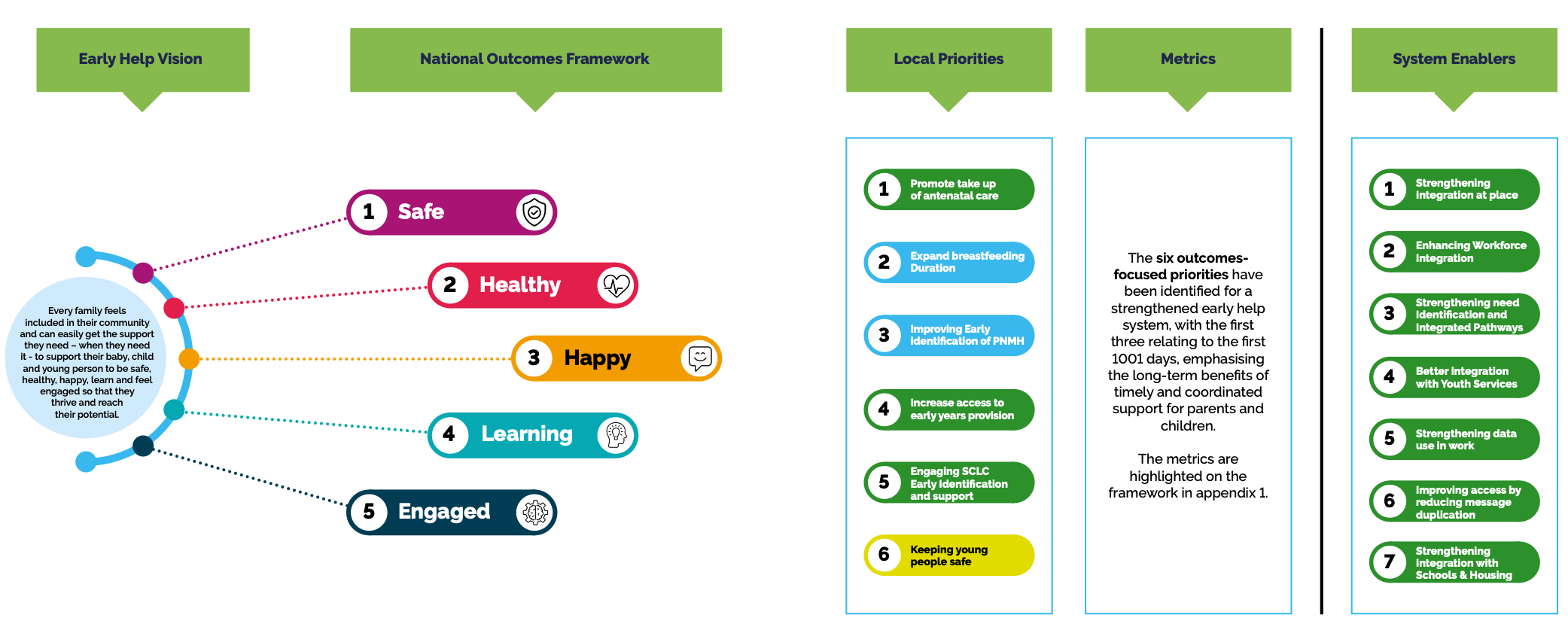
The strategy starts from a clear premise: families’ needs are complex and interconnected, so early help must be integrated, preventative and rooted in what matters most for babies, children, young people and families. The Common Outcomes Framework provides the shared language to do this, aligning partners around a small number of positive, strengths-based outcomes – such as children being healthy, safe, happy, learning and engaged – alongside outcomes for parents and carers and the systems that support them.
Family Hubs are positioned as a key delivery mechanism for this outcomes-led system, not as a standalone programme. By organising early help around locality-based hubs, Tower Hamlets has created a practical way for health, education, social care and voluntary sector partners to contribute to shared outcomes in place. The framework helps clarify how different services contribute to the same outcomes, even when their roles and interventions differ.
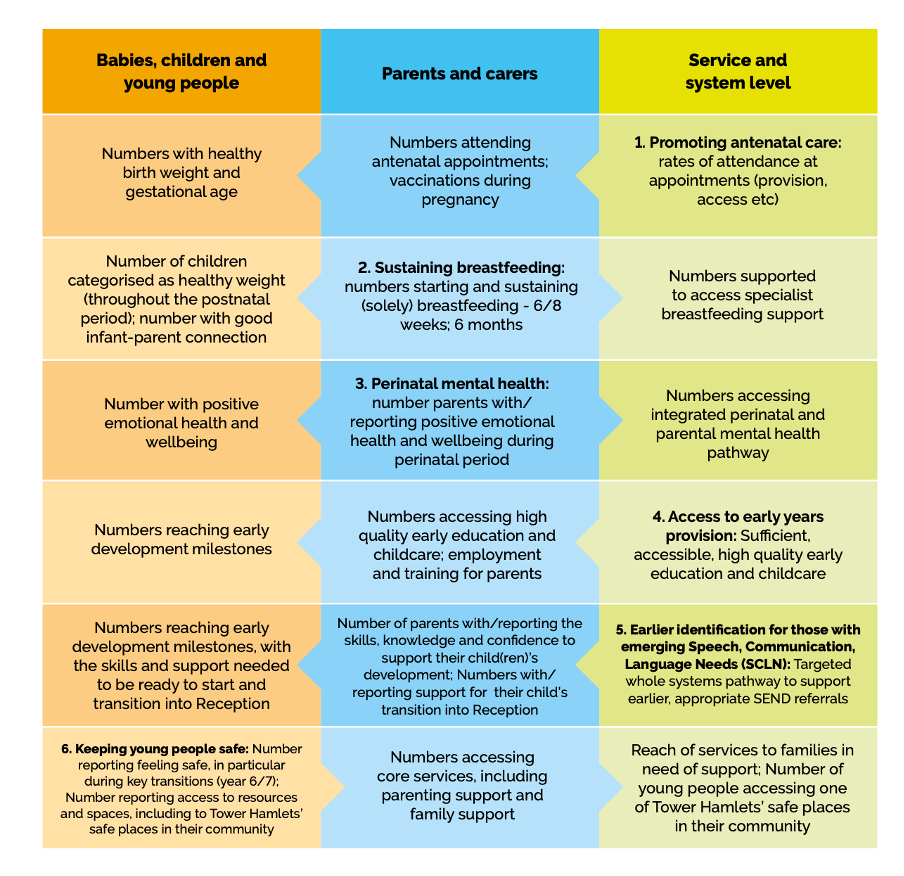
A notable feature of the strategy is its explicit focus on outcomes, not just activity. Rather than stopping at actions such as promoting antenatal care, the strategy sets out the difference these activities are expected to make, and how this will be monitored. This includes linking service activity to outcome measures – for example attendance, healthy birth weight and gestational age – strengthening the connection between delivery, learning and impact.
Diagram 2: Tracking outcomes through the system
The strategy also distinguishes clearly between outcomes for families and the system conditions needed to achieve them. Alongside ambitions for babies, children and parents, it identifies priorities such as shared leadership, integrated governance, better use of data and a commitment to learning and continuous improvement. This reflects a core principle of the Common Outcomes Framework: improving outcomes requires systems to work differently, not simply for individual services to do more.
By embedding the Common Outcomes Framework into its Early Help Strategy, Tower Hamlets has created a coherent spine that connects policy, partnership working, Family Hubs and data. The result is a strategy that is not driven by funding streams or service silos, but by a shared understanding of what success looks like for babies, children and families – and how the whole system is responsible for achieving it.